Contact us
T: +44 (0) 1480 759 812
E: enquiries@pestechnologies.com
Unit 32, Diss Business Hub, Diss Business Park, Hopper Way, Diss IP22 4GT
Contact us
T: +44 (0) 1480 759 812
E: enquiries@pestechnologies.com
Unit 32, Diss Business Hub, Diss Business Park, Hopper Way, Diss IP22 4GT
The soil is breathing. Nearly one-fifth of the carbon dioxide in the atmosphere originates from soils—about ten times more than human-made CO₂ emissions. This makes soil respiration a major contributor to overall carbon flux and a powerful indicator of soil health. In particular, heterotrophic or microbial respiration refers to the CO₂ released by soil microorganisms, and it is this process that we’ll be exploring in this article. Beneath our feet, countless microscopic organisms consume organic matter and release CO₂ as they respire. This natural process plays a crucial role in soil health and the global carbon cycle, yet it is highly sensitive to environmental conditions. Factors such as temperature, moisture levels, soil disturbance, and the availability of nutrients and carbon can significantly influence how much CO₂ is released, revealing important insights into the living dynamics of soil ecosystems.
What does microbial respiration tell me about my
soil?
Respiration is often best used with microbial biomass as a more complete picture of the biological health of soil. While microbial biomass is a proxy for the amount of microbial life in soil, respiration is used as a proxy for their activity, whether the life within your soil is working hard to break down nutrients and carbon.
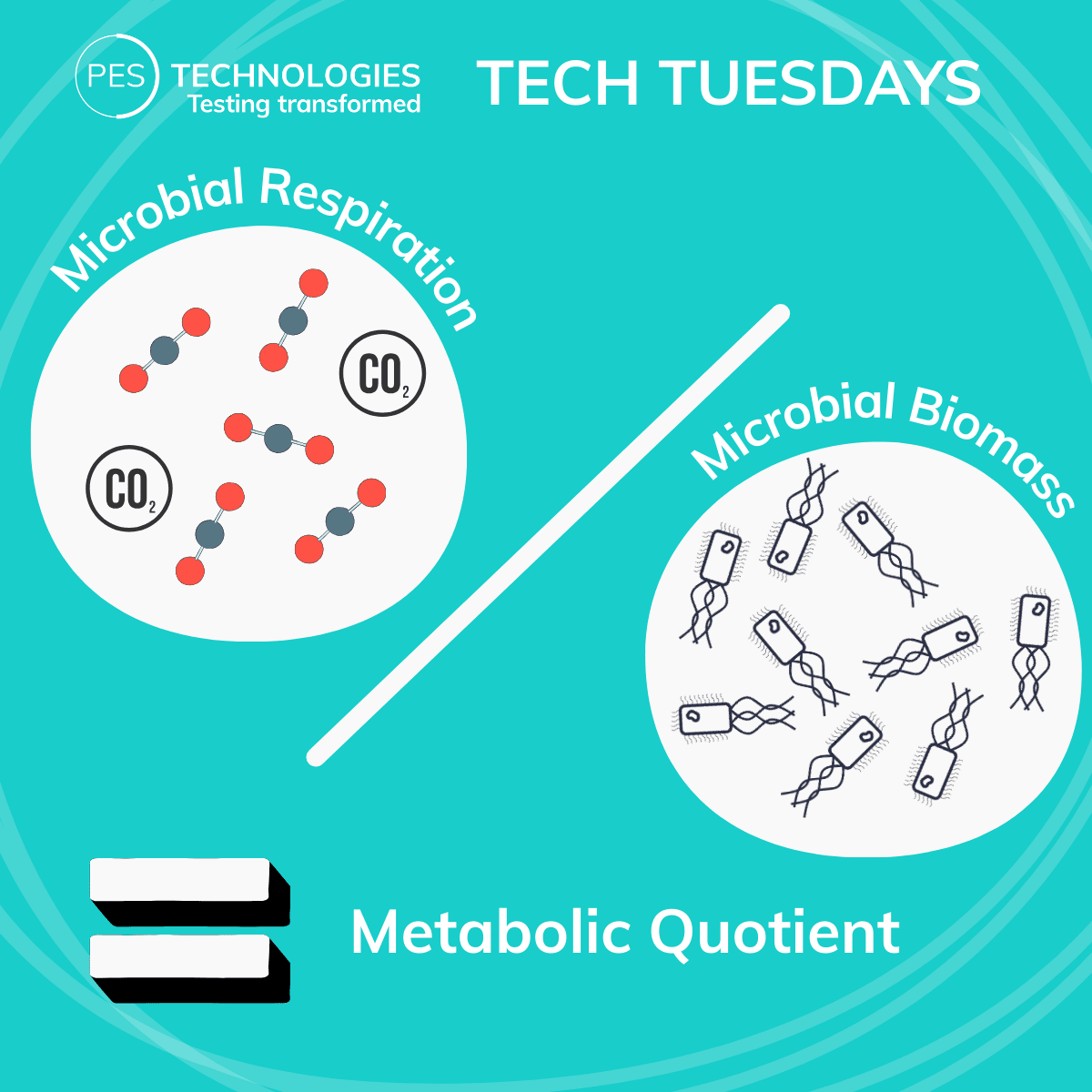
Without biomass, respiration levels could just represent the number of microbes, likewise, microbial biomass doesn’t reveal anything about activity or efficiency of your soil life. A simple calculation called the metabolic quotient shows you the ratio of microbial respiration (CO₂ released) to microbial biomass. This gives some perspective as to whether your soil life is working efficiently or stressed. PES Technologies represents qCO₂ (metabolic quotient) with a number between 0 and >2.3, which is the outcome of dividing microbial respiration with microbial biomass ugC/g (see image on left). Lower values (and higher efficiency) tends to show healthier soil and better carbon sequestration as less carbon is lost as CO₂. This is typically associated with healthier soils and improved carbon sequestration.
Higher qCO₂ values, on the other hand, may signal microbial stress, which can result from factors such as drought, compaction, nutrient imbalance, or pollution. In these conditions, microbes respire more carbon without building biomass, leading to greater carbon losses from the soil.
Why This Matters for Soil Management
Monitoring both microbial biomass and respiration, and interpreting them through the metabolic quotient, offers a valuable indicator of soil health. It can reveal whether agricultural practices are supporting efficient, resilient microbial communities or placing them under stress. By baselining and comparing metabolic quotients for reference areas, areas under different management, you can determine the effect of practices on your biological life. Helping you get a more complete picture of
soil health and how you can improve it.
Understanding how much microbial life is present and how effectively it functions helps guide better soil management decisions, supporting long-term productivity, resilience, and carbon storage. As always its important to take your respiration results in the context of your land, as different textures of soil and climates will promote certain levels of respiration, that’s why it’s important to baseline your soil respiration including a referce point to see what is ‘normal’ to your soil.
Interested about discovering your own soils microbial respiration? Reach out at info@pestechnologies.com