Contact us
T: +44 (0) 1480 759 812
E: enquiries@pestechnologies.com
Unit 32, Diss Business Hub, Diss Business Park, Hopper Way, Diss IP22 4GT
Contact us
T: +44 (0) 1480 759 812
E: enquiries@pestechnologies.com
Unit 32, Diss Business Hub, Diss Business Park, Hopper Way, Diss IP22 4GT
Plants only need a handful of things to grow: sunlight, nutrients, oxygen, and water. While innovations like hydroponics and vertical farming have transformed how and where we grow food, one thing remains constant — water is essential. Without it, photosynthesis stops and growth stalls. Understanding how water behaves in soil is therefore critical. Whether you’re deciding when to irrigate, assessing drought resilience, or measuring the impact of regenerative practices, two key metrics can offer valuable insight: Water Holding Capacity (WHC) and Field Water Content (FWC). They’re closely related, but they aren’t the same.
What’s the Difference?
Water Holding Capacity: Describes the total amount of water the soil can store and hold onto.
Field Water Content: It measures how much water is present in the soil’s pore space and available for plants at the moment the sample is taken.
What Influences Water Holding Capacity?
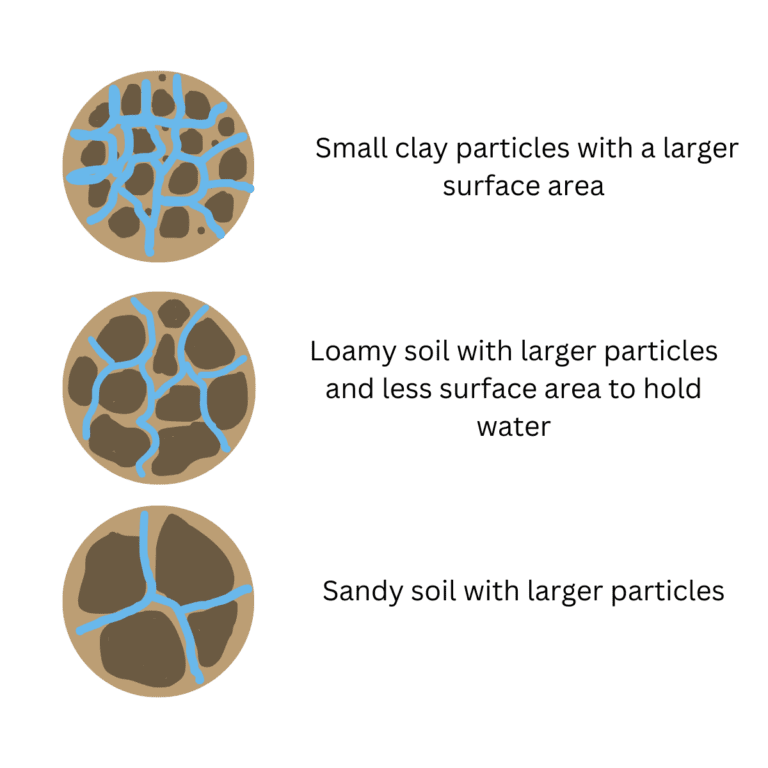
A soil’s ability to retain water is shaped by three main factors: texture, structure, and organic matter. Soil texture refers to the proportion of sand, silt, and clay particles. Sand particles are the largest, clay particles are the smallest, and silt sits in between. Smaller particles have a greater surface area, which allows them to hold onto more water. This is why heavier clay soils generally have a higher water holding capacity than sandy soils, which drain quickly.
Organic matter also plays a major role.
Materials like compost and manure act like a sponge, increasing the soil’s ability to store water while also improving aggregation and pore structure.
Regenerative practices such as cover cropping, reduced tillage, and no-till systems help build and protect organic matter, gradually increasing WHC over time.
Both indicators are measured in percentage of total soil volume. WHC can be around 5-10% in sandy soils, loamy soils 20-30% and clay soils up to 40% and more. FWC is usually between 10% for sandier soils and up to 50% for clay or peat soils with permanent wilting point – where there is no longer any water available for the plant.
Why Does It Matter?
A higher water holding capacity gives crops access to water when they need it — not just immediately after rain. This improves resilience during dry periods, reduces plant stress, and can significantly lower irrigation requirements.
Field Water Content complements this by helping you understand current soil moisture conditions. It can be used to fine-tune irrigation scheduling, assess whether crops are likely to experience water stress, and monitor how soil moisture changes across seasons or management practices.
How We Measure It
Water holding capacity and field water content are tests we carry out in-house from the samples we collect each Spring and Autumn. The process involves taking a field-moist soil sample, saturating it to 100% capacity, and then drying it in an oven for 24 hours to determine its dry weight. From this, we calculate soil water mass content and derive both WHC and FWC. We then put this data into our machine learning algorithm to continually improve accuracy.
When to Sample
Timing matters. Soil should be sampled under representative field conditions, avoiding extremes like immediately after heavy rainfall or prolonged drought. Consistent sampling and baselining allows for meaningful comparisons over time and helps track the impact of management changes