
Contact us
T: +44 (0) 1480 759 812
E: enquiries@pestechnologies.com
Unit 32, Diss Business Hub, Diss Business Park, Hopper Way, Diss IP22 4GT
Contact us
T: +44 (0) 1480 759 812
E: enquiries@pestechnologies.com
Unit 32, Diss Business Hub, Diss Business Park, Hopper Way, Diss IP22 4GT
On World Health Day, we’re thinking about the link between Human health and soil health. From soil microbes facilitating plant nutrient up take, to helping us avoid allergies, to providing us with life saving drugs, a healthy soil helps keep humans healthy.
Soil microbes act as the “digestive system” of the earth, breaking down organic matter and unlocking essential nutrients such as phosphorus, nitrogen and trace minerals.
Without a robust soil microbiome, crops may appear healthy but can be nutritionally depleted, lacking key elements like magnesium, zinc and iron that are critical for human health.
Research also shows that beneficial microbes can enhance plant production of antioxidants, improving the nutritional profile of crops (Patil et al, 2024).
The human gut and soil share a striking similarity – both rely on diverse microbial communities to regulate function, resilience and immunity.
Exposure to a wide range of soil microbes, particularly through food, plays a role in “training” the human immune system. Studies suggest this may help reduce the prevalence of allergies and autoimmune conditions (Kelly et al, 2022).
Soil is one of the most important sources of modern medicine.
Many antibiotics, including penicillin, were originally derived from soil microbes. Today, soil continues to be a critical source of compounds used in treatments for infection, inflammation and cancer.
As soil biodiversity declines, we risk losing access to future medical breakthroughs.
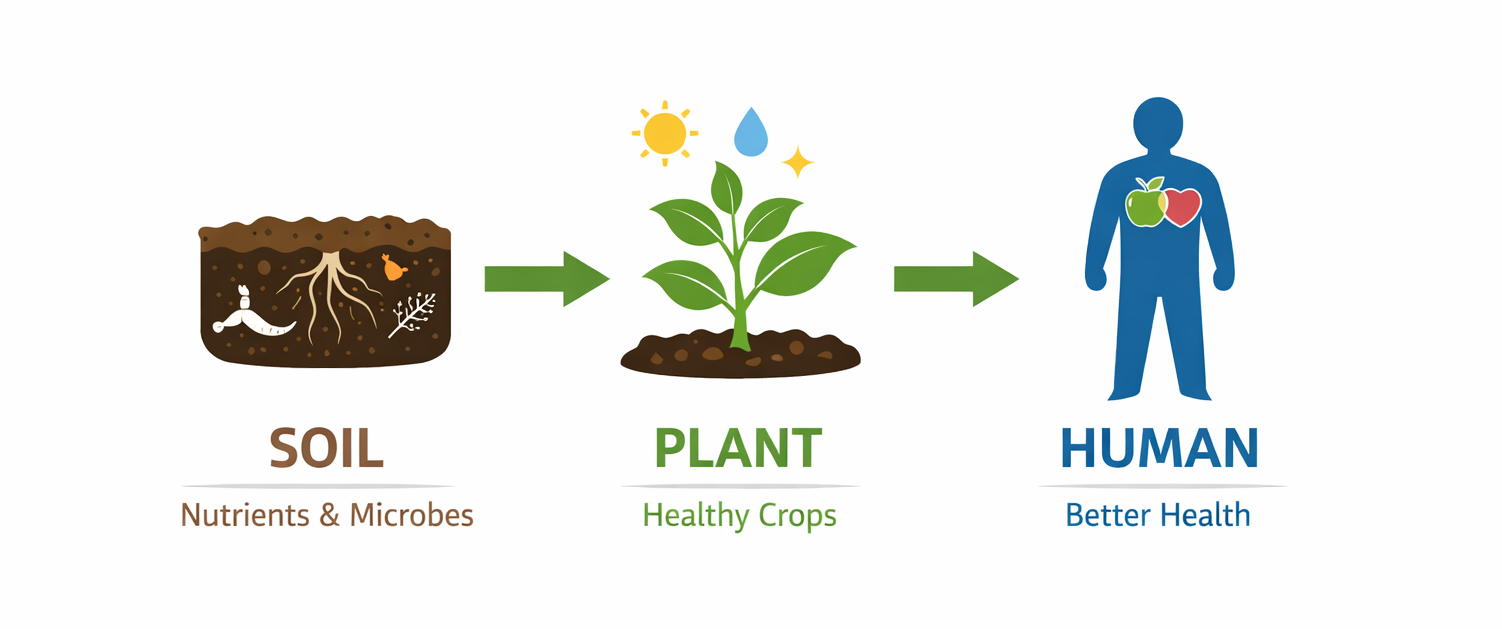
Healthy soils don’t just support plant growth – they influence food quality, resilience and long-term sustainability.
Farming practices that support soil biology – such as reduced disturbance, increased organic matter and maintaining living roots – can improve both soil function and crop nutritional value.
With increasing focus on regenerative agriculture, soil health monitoring and sustainable food production, understanding what’s happening in the soil is becoming more important than ever.
Understanding soil health isn’t just theoretical – it requires measuring biological activity and soil condition in the field.
Traditional lab testing can take time, but newer approaches allow for rapid, in-field assessment of soil biology, helping farmers and agronomists better understand soil condition at key decision-making moments.
With increasing pressure on food systems – from climate change to rising input costs – there is growing recognition that soil health underpins both agricultural productivity and human health outcomes.
World Health Day is a reminder that improving health doesn’t start in hospitals – it starts in the soil.
We cannot have healthy people on a sterilised planet.
By restoring soil organic matter, microbial biomass and biological activity, we are not just improving soil – we are supporting healthier food systems and, ultimately, healthier people.