The Living Foundation: Understanding Regenerative Agriculture

In recent years, the conversation around food systems has shifted from sustainability, maintaining what we have, to regeneration,improving our agricultural system. While conventional agriculture often views soil as a passive medium for holding plants, regenerative agriculture treats the soil as a dynamic, living ecosystem.

At its core, regenerative agriculture is a system of farming principles and practices that seeks to rehabilitate the entire ecosystem by focusing on soil health and carbon sequestration.

The Five Core Tenets of Regeneration

To understand how a farm transitions from extractive to regenerative, scientists and practitioners look at five foundational pillars:

  1. Minimize Soil Disturbance

Mechanical Tillage (ploughing) physically disrupts the complex “highways” of fungal mycelium and collapses the pore spaces where air and water circulate, damaging soil structure. By adopting no-till or minimum-till methods and direct drilling, the soil maintains its structural integrity.

  1. Maximise Crop Diversity

Monocultures (growing a single crop) lead to a “specialised” and often fragile soil microbiome. In contrast, diverse plantings—including multi-species cover crops—ensure a wide variety of root exudates. This variety supports a more resilient and diverse community of bacteria and fungi, which in turn improves nutrient cycling.

  1. Maintain Living Roots Year-Round

In a natural ecosystem, the ground is rarely bare. Regenerative systems prioritise keeping living roots in the ground at all times. These roots provide a constant supply of sugars (carbon) to the soil microbiome, preventing the microbial population from starving or becoming dormant during the off-season.

  1. Keep the Soil Covered

This tenet involves leaving crop residues on the surface or using cover crops to shield the earth. This cover performs three critical functions:

  • Thermal Regulation: Buffers the soil against extreme temperature swings.
  • Moisture Retention: Reduces evaporation.
  • Erosion Control: Prevents the loss of topsoil from wind and rain.
 
  1. Integrate Livestock

Nature rarely separates animals from plants. In regenerative systems, planned grazing mimics the movement of wild herds. As livestock graze, their waste provides concentrated biological “inoculants” and natural fertilizers, while their hooves can help incorporate organic matter into the upper soil layers, stimulating further plant growth.

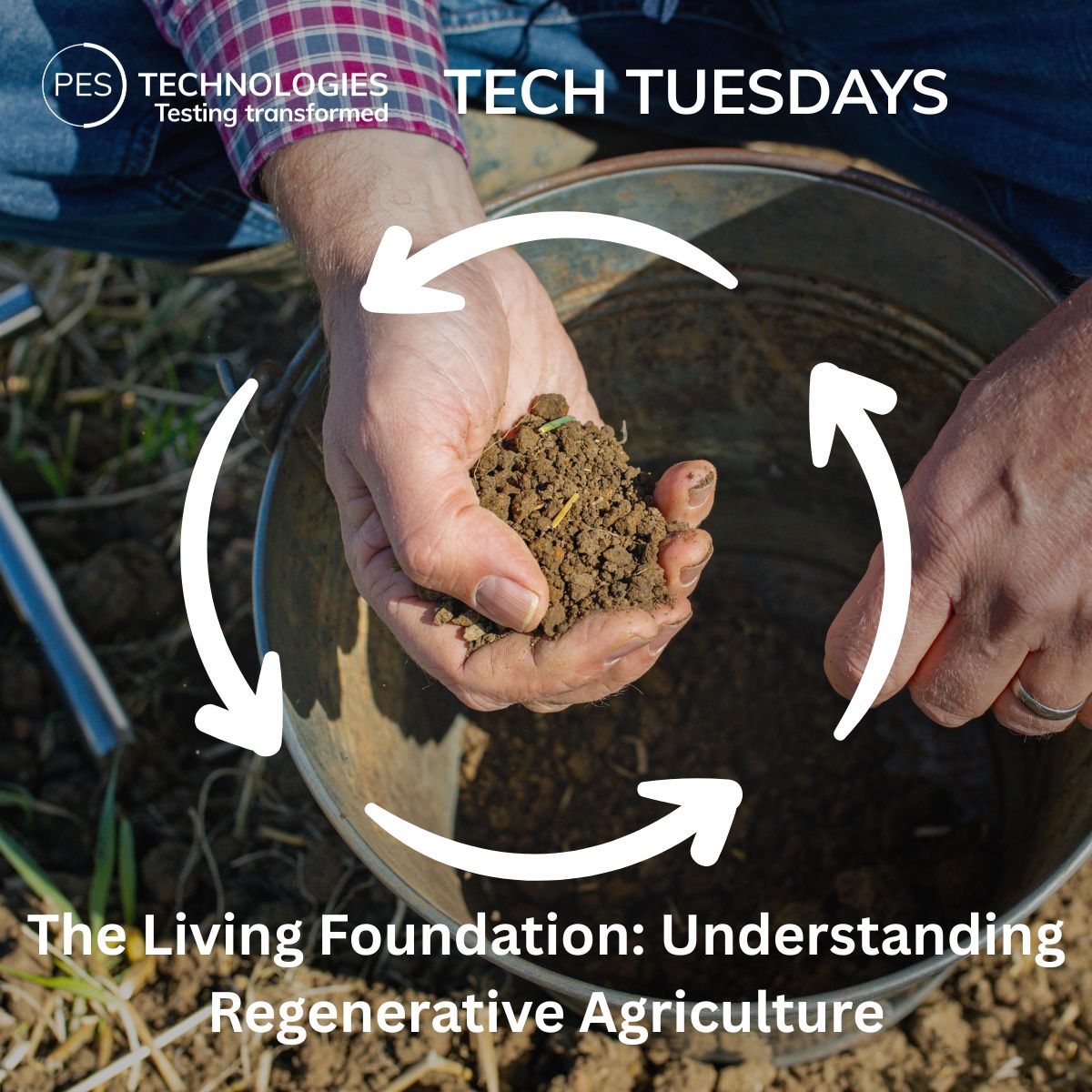
Image of soil in a hand

The Ultimate Goal: The Carbon Cycle

The success of these tenets is often measured by the increase in Soil Organic Matter (SOM). For every 1% increase in SOM, an acre of land can hold an additional 20,000 gallons of water.

By feeding the microbial biomass, atmospheric CO₂ is converted into stable, mineral-associated organic matter. In this way, the farm ceases to be a carbon source and becomes a significant carbon sink.

Contact PES Direct, to arrange rapid soil testing directly on your land.

World Health Day 2026: Why Wellness Starts in the Dirt

World Health Day 2026: Why Wellness Starts in the Dirt

On World Health Day, we’re thinking about the link between Human health and soil health. From soil microbes facilitating plant nutrient up take, to helping us avoid allergies, to providing us with life saving drugs, a healthy soil helps keep humans healthy.  

Read More »
Image of soil in a hand

The Living Foundation: Understanding Regenerative Agriculture

In recent years, the conversation around food systems has shifted from sustainability, maintaining what we have, to regeneration,improving our agricultural system. While conventional agriculture often views soil as a passive medium for holding plants, regenerative agriculture treats the soil as a dynamic, living ecosystem.

Read More »

Q1 Newsletter 2026

As spring arrives across the UK, farmers and agronomists are preparing for the season ahead following one of the wettest winters in recent memory. Extended rainfall can affect soil structure, oxygen levels and biological activity beneath the surface, making this an important moment to understand what’s happening in your fields.

Read More »